
Quick answer
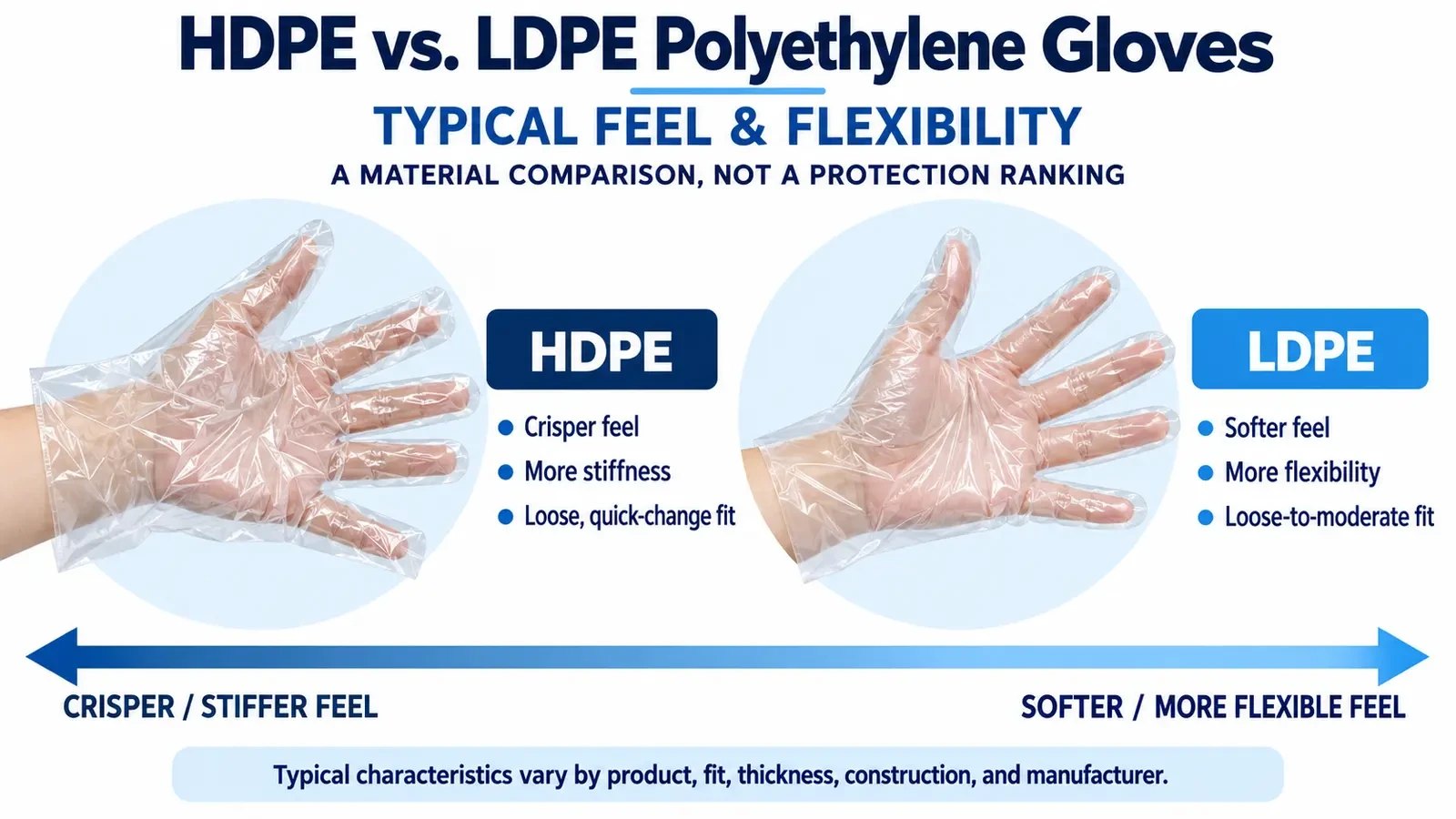
HDPE and LDPE gloves are both made from polyethylene film, but they generally feel and perform differently. HDPE gloves are typically crisper and stiffer, while LDPE gloves are generally softer and more flexible.
Both are commonly made as loose-fitting disposable gloves that are easy to put on and remove during short tasks. Neither material is automatically the better choice for every application. The finished glove's thickness, construction, fit, labeling, and intended use are more important than the material abbreviation alone.
Key distinction
HDPE and LDPE describe types of polyethylene. They do not, by themselves, establish that a finished glove is food-contact compliant, medical grade, chemical resistant, or suitable for a particular workplace.
What do HDPE and LDPE mean?
HDPE stands for high-density polyethylene, while LDPE stands for low-density polyethylene. Both belong to the polyethylene family, but differences in molecular branching and density contribute to different material characteristics.
HDPE is generally associated with greater stiffness and a more structured feel. LDPE is generally associated with greater flexibility and softness. When these materials are converted into very thin disposable gloves, the differences may be noticeable in how the gloves feel, move, sound, and conform to the hand.
Density is only one part of the finished product. Resin formulation, film thickness, embossing, dimensions, seams, manufacturing method, and quality control can all affect glove performance. Buyers should compare the specifications and intended use of the actual glove rather than relying only on the terms HDPE or LDPE.
HDPE vs. LDPE gloves: Quick comparison
| Feature | HDPE gloves | LDPE gloves |
|---|---|---|
| Full name | High-density polyethylene | Low-density polyethylene |
| Typical feel | Crisper and stiffer | Softer and more flexible |
| Typical fit | Loose fitting | Loose fitting, sometimes slightly more conforming |
| Ease of changing | Designed for quick on-and-off use | Designed for quick on-and-off use |
| Common task pattern | Short, frequent-change tasks | Short tasks where a softer feel may be preferred |
| Important limitation | Material name alone does not establish protection level or approved use | Material name alone does not establish protection level or approved use |
| What buyers should verify | Thickness, dimensions, texture, seams, labeling, and intended use | Thickness, dimensions, texture, seams, labeling, and intended use |
What are HDPE gloves?
HDPE gloves are disposable gloves manufactured from high-density polyethylene film. They are commonly lightweight, loose fitting, and shaped from layers of film joined around the edges.
Compared with LDPE gloves, HDPE gloves usually have a firmer, crisper feel and less flexibility. Their loose construction can make them convenient for short tasks that require workers to remove and replace gloves frequently.
- Food preparation and serving tasks, when the finished glove is labeled for the intended food-contact use
- Deli and counter service
- Bakery and cafeteria tasks
- Light cleaning or general-purpose work compatible with the glove's labeling
- Short activities requiring frequent glove changes
HDPE is a material description, not a protection rating. Suitability depends on the finished glove's specifications, regulatory status, workplace risk assessment, and manufacturer instructions.
What are LDPE gloves?
LDPE gloves are disposable gloves manufactured from low-density polyethylene film. They are also generally loose fitting and intended for short-duration tasks, but they commonly feel softer and more flexible than HDPE gloves.
The softer film may provide a less rigid feel during simple handling tasks. However, LDPE gloves should not automatically be described as more protective, more durable, or more suitable for prolonged wear. Actual performance varies by product design and construction.
- Food preparation and serving tasks, when the finished glove is labeled for the intended food-contact use
- Handling ready-to-eat foods with an appropriately labeled glove
- Light housekeeping and sanitation tasks compatible with the product's labeling
- General-purpose handling
- Short activities where a softer glove feel may be preferred
As with HDPE gloves, buyers should review the finished product's thickness, size, texture, seams, intended use, and supporting documentation before selection.
Where do CPE gloves fit?
In disposable glove catalogs, CPE commonly refers to cast polyethylene gloves. The term usually describes a polyethylene film made through a casting process rather than identifying the material only by density.
CPE gloves may have a different texture, thickness, drape, or feel from common blown-film HDPE and LDPE gloves. However, CPE products also vary, so buyers should compare the actual specifications instead of assuming that every CPE glove performs the same way.
The abbreviation CPE can have different meanings in other material contexts. When reviewing a glove, verify how the manufacturer defines CPE and examine the finished product's documentation, labeling, and intended use.
Do not choose by abbreviation alone
HDPE, LDPE, and CPE are useful starting points, but the finished glove's construction and documented intended use should guide the final decision.
Common uses for disposable polyethylene gloves
Disposable polyethylene gloves are commonly selected for short, light-duty tasks where gloves must be changed frequently. Their loose fit can make them faster to put on and remove than closer-fitting disposable gloves.
Common applications may include:
- Food preparation and serving
- Deli, bakery, cafeteria, and concession work
- Handling ready-to-eat foods
- Light housekeeping and sanitation tasks
- General-purpose handling
- Tasks requiring frequent glove changes
These are general examples, not universal approvals. The finished glove must be labeled and documented for its intended application. Workplace procedures and applicable requirements should also guide selection.
Can HDPE and LDPE gloves be used for food handling?
Polyethylene gloves are widely used in food-service settings, but the material name alone does not establish that every HDPE or LDPE glove is appropriate for food contact.
For food handling, verify that the finished glove is labeled or documented for the intended food-contact application. Employees must also follow proper handwashing and glove-changing procedures. A disposable glove does not replace hand hygiene, and it should be changed when it becomes damaged, contaminated, or when the worker changes tasks.
When handling ready-to-eat food, follow the applicable food-safety rules and workplace procedures for preventing bare-hand contact and cross-contamination. Gloves should not be washed or reused as a substitute for changing them.
Food-handling reminder
Choose a finished glove that is documented for the intended food-contact use, and treat glove changes and handwashing as part of the food-safety process.
How to choose between HDPE and LDPE gloves
The right choice depends on the task, the finished glove, and the workplace requirements—not simply on which polyethylene type sounds stronger.
1. Start with the task
Identify what the wearer will handle, how long the task will last, how frequently gloves must be changed, and whether the work involves food, bodily fluids, chemicals, sharp objects, heat, or other hazards. Lightweight polyethylene gloves are generally associated with short, low-risk tasks rather than every type of hand protection.
2. Decide which feel is more practical
HDPE gloves are generally crisper and stiffer. LDPE gloves are generally softer and more flexible. If quick glove changes are the main priority, either type may be appropriate when the finished product is labeled for the task. If a softer feel is preferred, an LDPE glove may be worth evaluating.
3. Compare the finished construction
Review film thickness, glove dimensions, texture, seams, cuff shape, ambidextrous design, and packaging. Two gloves carrying the same material abbreviation may still feel and perform differently because of their construction.
4. Verify labeling and documentation
Check the manufacturer's stated intended use and any supporting compliance or regulatory documentation required for the workplace. Do not infer food-contact suitability, medical status, chemical resistance, or protection level from HDPE or LDPE alone.
5. Test the glove in the actual workflow
When possible, evaluate a sample in the real task. Confirm that workers can put the glove on, complete the intended activity, remove it without unnecessary difficulty, and change gloves as often as required.
Limitations of HDPE and LDPE gloves
HDPE and LDPE gloves are commonly lightweight and loose fitting. Those characteristics can be useful for frequent changes, but they also mean these gloves should not automatically be selected for work requiring a close fit, extended wear, high dexterity, or documented protection from significant hazards.
Unless the finished product is specifically labeled and cleared for that purpose, do not assume a polyethylene glove is appropriate for medical examinations, contact with bodily fluids, chemical handling, hazardous cleaning agents, or tasks involving sharp objects.
No disposable glove should be described as puncture-proof, chemical-proof, or universally suitable. If the task presents a meaningful hazard, use the workplace risk assessment and manufacturer documentation to select an appropriate glove.
Material is not a protection rating
HDPE and LDPE identify polyethylene types. They do not replace the finished glove's specifications, testing, intended-use labeling, or workplace safety requirements.
Common purchasing mistakes
Choosing only by price
A lower case price does not necessarily mean the glove is the better value for a particular workflow. Consider glove count, dimensions, thickness, change frequency, packaging, worker acceptance, and suitability for the task.
Assuming HDPE is automatically better than LDPE
Higher density does not make every HDPE glove the correct choice. A stiffer feel may be useful in one workflow and inconvenient in another. Selection should be based on the finished glove and intended task.
Treating all polyethylene gloves as identical
HDPE, LDPE, and CPE gloves can differ in feel, film construction, texture, dimensions, and manufacturing method. Products within the same category can also vary by manufacturer.
Assuming the material name proves compliance
Terms such as HDPE, LDPE, and polyethylene do not by themselves prove food-contact compliance, medical clearance, chemical resistance, or any specific protection level. Verify the documentation for the actual finished product.
Using light-duty gloves for higher-risk work
Do not select a lightweight polyethylene glove for hazardous work merely because it is inexpensive or easy to change. Tasks involving bodily fluids, chemicals, sharp objects, heat, or other significant hazards require an appropriate risk assessment and properly documented hand protection.
Frequently asked questions
What is the main difference between HDPE and LDPE gloves?
HDPE gloves generally feel crisper and stiffer, while LDPE gloves generally feel softer and more flexible. Both are commonly loose-fitting polyethylene gloves intended for short tasks and frequent changes. Actual performance depends on the finished glove's thickness, construction, dimensions, texture, labeling, and intended use.
How can you tell HDPE and LDPE gloves apart?
The feel of the film may provide an initial clue: HDPE is typically firmer and more crisp, while LDPE is typically softer and more flexible. Appearance alone is not a reliable identification method, however. Confirm the material using the product label, specification sheet, or manufacturer documentation.
Are LDPE gloves better than HDPE gloves?
Not automatically. LDPE may be preferred when a softer and more flexible feel is useful, while HDPE may be preferred when a crisper and more structured feel works better in the workflow. The correct choice depends on the task and the finished product's documented intended use.
What are the disadvantages of HDPE gloves?
HDPE gloves are generally loose fitting and may feel stiffer or noisier than softer disposable glove materials. They may be less comfortable for tasks requiring a close fit, prolonged wear, or fine dexterity. These are typical characteristics, and individual products can vary.
What are the disadvantages of LDPE gloves?
LDPE gloves are also generally loose fitting and intended for short, light-duty tasks. Their softer feel does not mean they are automatically suitable for extended wear, hazardous work, medical use, chemical handling, or tasks requiring documented protection. Product specifications and labeling must be reviewed.
Can HDPE and LDPE gloves be used for food handling?
They may be used for food handling when the finished glove is labeled or documented for the intended food-contact application. The material abbreviation alone is not enough. Workers must also follow applicable handwashing, glove-changing, and cross-contamination procedures.
What is the difference between LDPE and CPE gloves?
LDPE identifies low-density polyethylene. In disposable glove catalogs, CPE commonly refers to cast polyethylene and usually describes a different film-production method. CPE gloves may differ in texture, drape, thickness, and feel, but manufacturers may use terminology differently, so buyers should verify the product documentation.
Are polyethylene gloves suitable for medical examinations?
Do not assume that a glove is suitable for medical examinations because it is made from polyethylene. Medical suitability depends on the finished device's labeling, regulatory status, testing, and intended use. Use an appropriately cleared and documented medical examination glove when that level of protection is required.
Key takeaways
- HDPE and LDPE are both types of polyethylene, but they generally produce gloves with a different feel.
- HDPE gloves are typically crisper and stiffer, while LDPE gloves are typically softer and more flexible.
- Both types are commonly loose fitting and used for short tasks requiring frequent glove changes.
- CPE commonly refers to cast polyethylene in disposable glove catalogs, but the manufacturer's terminology should be verified.
- Material abbreviations do not establish food-contact compliance, medical status, chemical resistance, or protection level.
- Choose from the finished glove's specifications, labeling, intended use, workplace risk assessment, and actual task requirements.
Related resources
- Polyethylene Gloves
- TPE vs. Vinyl Gloves: What's the Difference?
- Disposable Glove Thickness Guide
- Nitrile vs. Vinyl vs. Latex Gloves: What's the Difference?
Sources
- Google Search Central — Influencing Your Title Links in Search Results
- Dow — Low Density Polyethylene (LDPE)
- ExxonMobil Product Solutions — High Density Polyethylene Product Guide
- U.S. Food and Drug Administration — 2022 Food Code
- U.S. Food and Drug Administration — Medical Gloves
This guide is for general educational purposes. PPE selection should follow the applicable manufacturer instructions, workplace risk assessment, food-safety procedures, infection-prevention procedures, and regulatory requirements.